Travels to the miracles of technology
World’s oldest transporter bridge
Vizcaya Bridge
Location: Portugalete/Getxo near Bilbao, Spain
Built in: 1893
What?
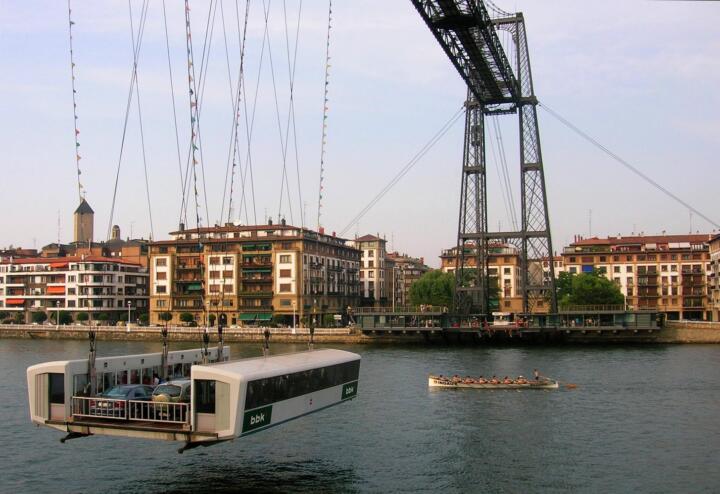
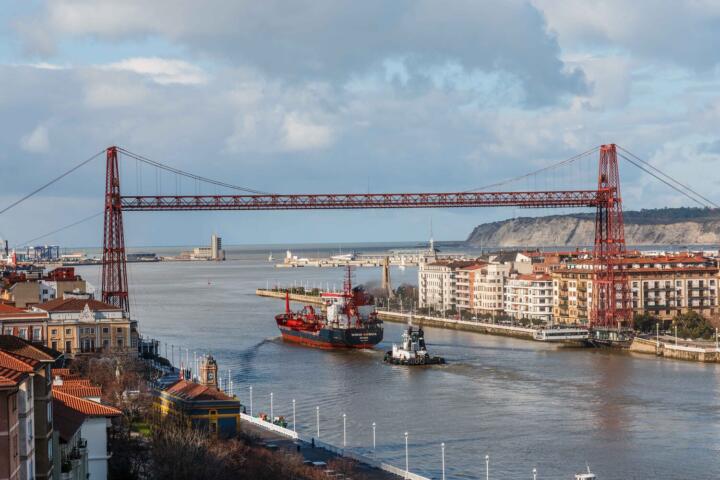
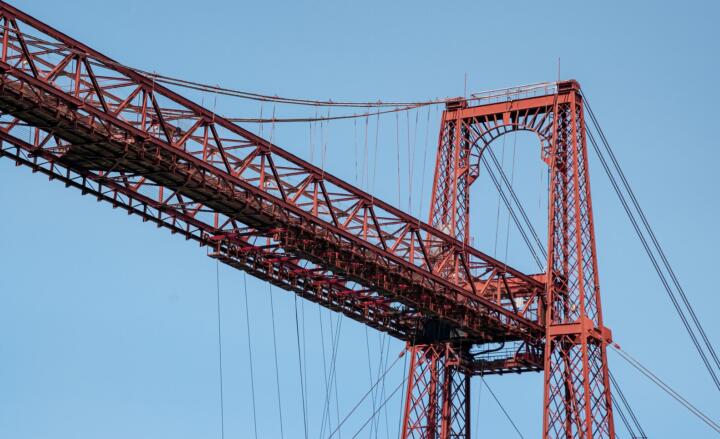
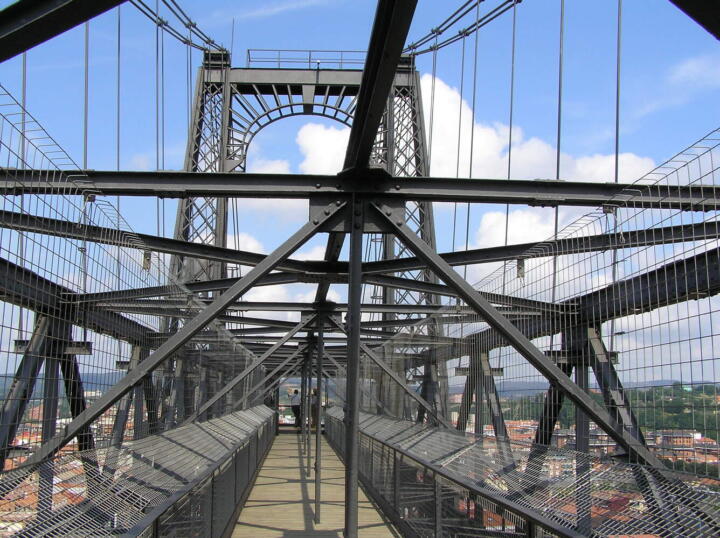
It looks like a suspended bridge – but isn’t. The Vizcaya Bridge was the world’s first transporter bridge and to this day has been carrying cars, cyclists, and pedestrians in a gondola suspended from a steel construction across the river Nervión. Since 2006 it has been a UNESCO World Heritage Site.
The technology behind it:
Instead of a classic road a motorized trolley runs across a 160-meter (525-foot) long steel beam at a height of 45 meters (148 feet). Suspended from it is a gondola that can haul up to twelve vehicles and some 200 passengers per passage. The brilliant concept is that ships can pass without obstructions while people and vehicles can cross the river at the same time – a revolutionary engineering solution of the industrial age.
Why fascinating?
More than 130 years after it was opened the bridge is still in daily service. Some 300 crossings per day and about four million passengers and half a million vehicles a year show that sometimes good engineering is simply timeless.
Europe’s longest urban cable car
Câble C1
Location: Île-de-France in Grand Paris
Opened in: 2025
What?
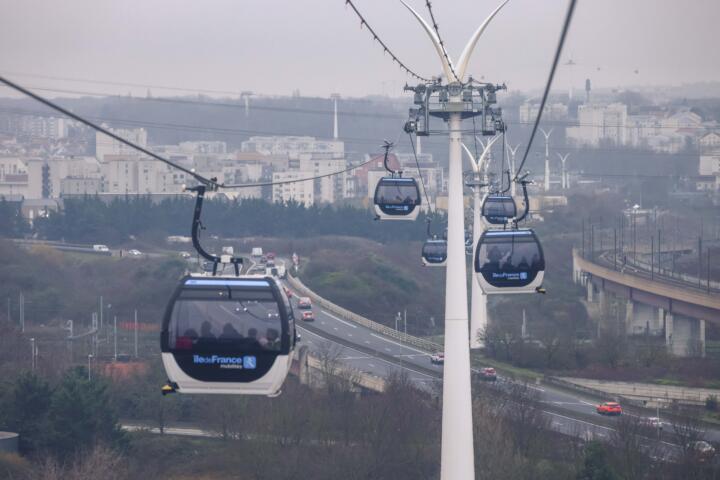
Instead of being stuck in a traffic jam commuters now just hover above it. Câble C1 was Europe’s longest urban cable car to be opened last year in Grand Paris. The 4,500-meter (14,760-foot) long route connects several suburbs directly with the Paris Metro network, linking neighborhoods that used to be accessible only with difficulty by bus. About 11,000 passengers are expected to use the “airborne Métro” every day.
The technology behind it:
The monocable circulating system uses 105 cabins each of which can accommodate ten passengers, bicycles, strollers, and wheelchairs. Every 30 seconds a gondola leaves the station, achieving a hauling rate of 1,600 people per hour and direction. The system needs 18 minutes to cover the 4.5-kilometer (2.8-mile) long distance with five stations and 30 pylons (speed: 6 meters/20 feet per second) – buses need around 40 minutes for the same connection. The system was built for around 138 million euros.
Why fascinating?
Câble C1 shows how alpine technology can turn into urban infrastructure. Where dense construction makes it difficult to expand classic traffic routes cable cars rise to the challenge. They require little space, glide across obstacles almost silently, and make traffic three-dimensional. What used to be seen nearly exclusively as a tourist attraction for decades is increasingly evolving into a true alternative for local transportation – not only in Paris but also in other European cities such as Toulouse.
World’s largest ship lift
Three Gorges Dam
Train in the clouds
Tren a las Nubes
Location: Salta/Argentina to Antofagasta/Chile
Built in: 1921–1948
What?
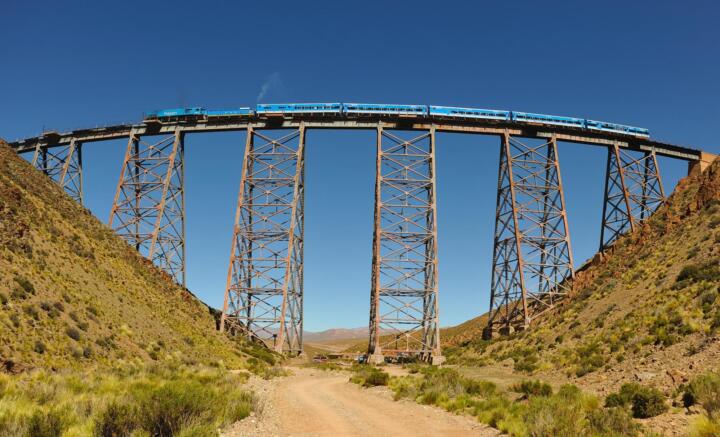
A railroad that was carved through the Andes within a construction time of three decades. At an elevation of 4,220 meters (13,845 feet) if not earlier it’s clear why the railroad is called Tren a las Nubes – “train in the clouds”. Here the train sometimes runs through fields of clouds. It passes through the world’s highest train stations, surpassed only by the Chinese Qingzang Railway. The original purpose hadn’t been tourism but mining: the Argentine copper, saltpeter, and borax mines were supposed to receive a connection to the Chilean port city of Antofagasta.
The technology behind it:
Led by American engineer Richard Maury, more than 1,500 workers for 27 years at times laid railroad ties and tracks through unhospitable terrain – 21 tunnels, 31 bridges, and 13 viaducts were necessary to overcome nearly 3,200 vertical meters (10,500 vertical feet). Because cog railways would have been too complex Maury developed a specific technology enabling the incline to be managed strictly by the locomotive’s engine power, supported by two sweep loops and two hairpin bends. The pinnacle of the route is the La Polvorilla viaduct, a prestressed steel bridge with a length of 224 meters (735 feet) and a height of 63 meters (206 feet) the construction of which started in 1937 and that was opened on November 7, 1939. The complete route to Chile was completed only in 1948.
Why fascinating?
Because pure improvisation meets with top achievements in this case: no gears, no modern construction engineering – only diesel power, patience, and an engineer who knew the air of the Andes better than anyone else. Because of the altitude the train is always accompanied by healthcare personnel with oxygen bottles.
Europe’s highest outdoor elevator
Hammetschwand Elevator
Location: Bürgenstock, canton of Nidwalden (Switzerland)
Built in: 1905
What?
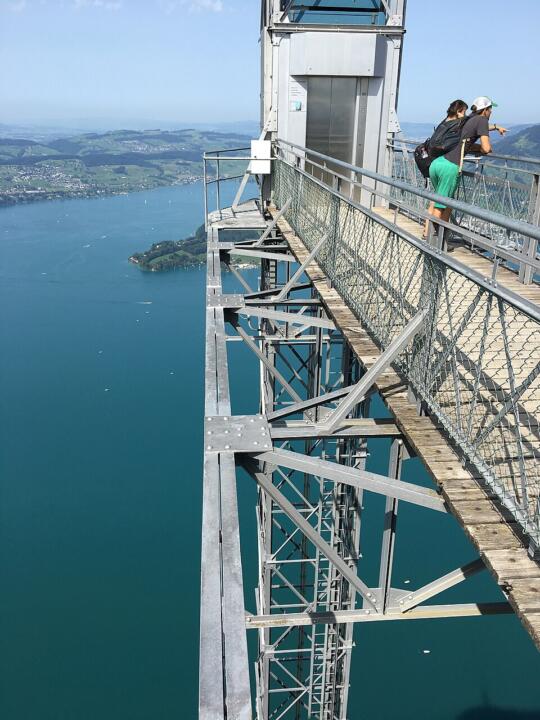
An elevator that has become tourist destination in its own right: The Hammetschwand Elevator inside the Bürgenstock Mountain spectacularly raises along a near-vertical rock above Lake Vierwaldstättersee. With a height of nearly 154 meters (505 feet), it’s the tallest outdoor elevator in Europe, connecting the rock trail with the Hammetschwand overlook – including a spectacular passage across the lake and the Alps.
The technology behind it:
When the lift was opened in 1905 it was a technical sensation. The cabin, then made of wood and lined with zinc sheet accommodated eight people and carried a load of 600 kilograms (1,320 lbs.). The ride took a little less than three minutes at a speed of about one meter (3 feet) per second. The start in those days, though, was anything but comfortable: the movement of the cabin was rough and uneven due to tension fluctuations.
Over time, the system saw several modernizations. During a comprehensive refurbishment in 1959/1960 the tower was reinforced, the corrosion protection renewed, and a modern elevator drive with smooth acceleration control installed. That made it possible to increase speed to four meters (13 feet) per second. Following another partial refurbishment in 1981, the elevator was reopened in 1992 with a completely renewed glazed cabin. In the process, speed was deliberately reduced to 3.15 meters (10 feet) per second – to make not only the destination but also the ride itself a special experience. The elevator covers the nearly 154 vertical meters (505 vertical feet) in around 50 seconds. The original drive was a hydraulic unit, today an electric motor moves the cabin.
Why fascinating?
The fascination also lies in the system’s scale. On a surface area of just 2 by 2 meters (6.6 by 6.6 feet), the elevator in the filigree-like metal tower overcomes nearly 154 vertical meters. The basic idea behind the elevator has been retained to this day – not to dominate the landscape but to make it experienceable.
World’s most photographed structure
Golden Gate Bridge
Location: San Francisco, USA
Built in: 1933–1937
What?
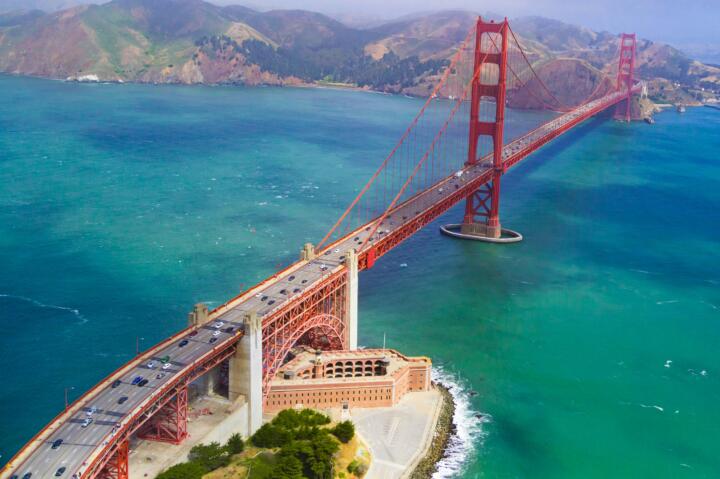
A bridge the construction of which should actually not have been feasible – due to strong tides and currents, ferocious winds, and – a strait that is too wide. Upon its completion, the bridge broke several records: a pylon with 227 meters (744 feet), the longest and thickest cable harnesses, and the largest underwater foundation. Its span of 1,280 meters (4,200 feet) between the towers made it the world’s largest suspension bridge in 1937 – a title it had to cede to the Verrazzano-Narrows Bridge in New York City only in 1964.
The technology behind it:
For the southern foundation, initially an oval concrete ring was established that was designed to prevent ship collisions and reached a height of 37 meters (121 feet) – only within that protective ring could the actual pylon foundation be built in relatively calm waters. The ten-story tall foundations of the south pylon were built 340 meters (1,115 feet) offshore in deep water; the temporary auxiliary construction bridge was destroyed by a ship and damaged by winds several times so that the foundation work alone took two years. The two main cables are nearly one meter (3.3 foot) thick and spun from a total of 129,000 kilometers (80,000 miles) of wire. The builders suspended a safety net underneath the bridge that prevented more than 19 workers from falling – even so, 11 workers lost their lives during the project.
Why fascinating?
The characteristic color “International Orange” was originally a primer – The U.S. Navy and Air Force had wanted to paint black-yellow or red-white until architect Irving Morrow prevailed. In terms of construction technology, the bridge has been staying in motion to this day: after the Loma-Prieta earthquake in 1989, it was retrofitted with vibration dampers and in 2023 a stainless-steel net underneath the walkways was added.
Continental Europe’s first large river tunnel
St. Pauli Elbe Tunnel
Location: Hamburg, Deutschland
Built in: 1907–1911
What?
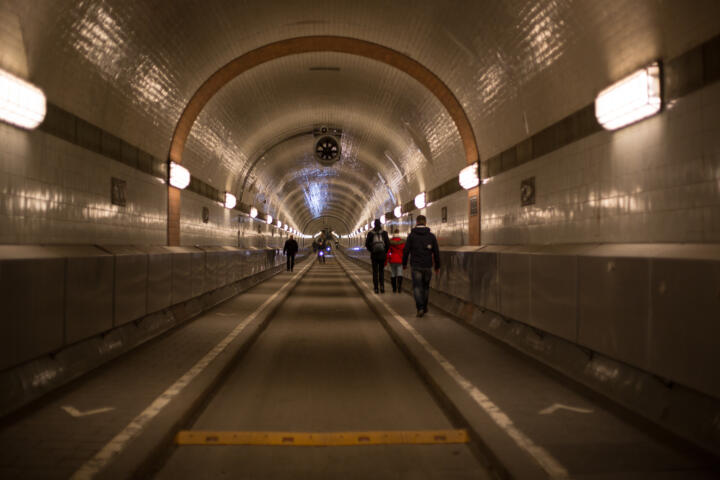
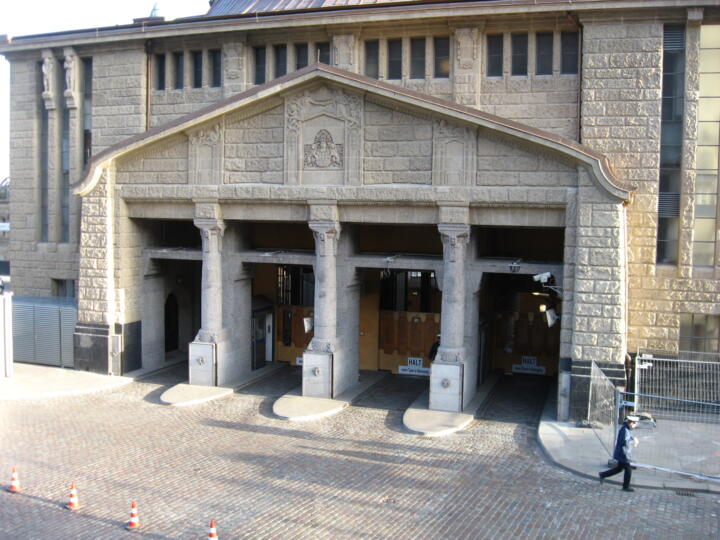
A hole through the river where there was really no room for one. When the St. Pauli Elbe Tunnel was opened on September 7, 1911 it was Continental Europe’s first large river tunnel – 426,5 meters (1,398 feet) long, down to 24 meters (80 feet) beneath the Elbe River, it connects the docks with the Steinwerder dock island. It wasn’t built for tourists but for tens of thousands of port and dock workers that previously had to depend on overcrowded, weather-dependent ferries. A bridge was out of the question – it would have obstructed ship traffic. Consequently, the digging project was started.
The technology behind it:
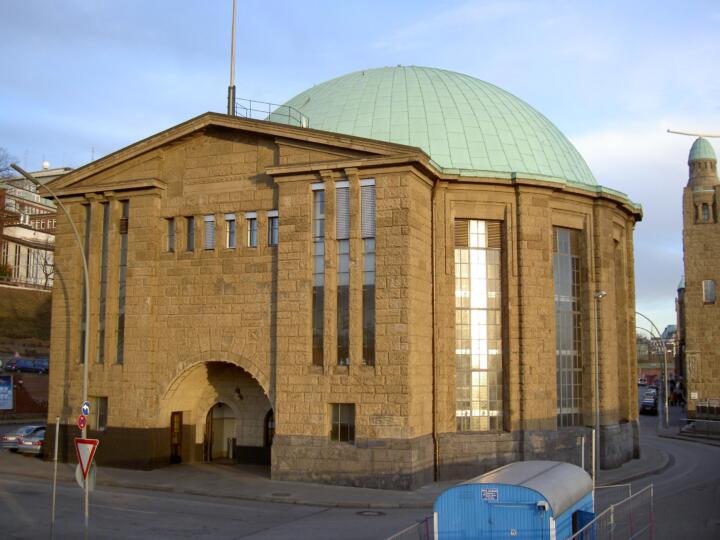
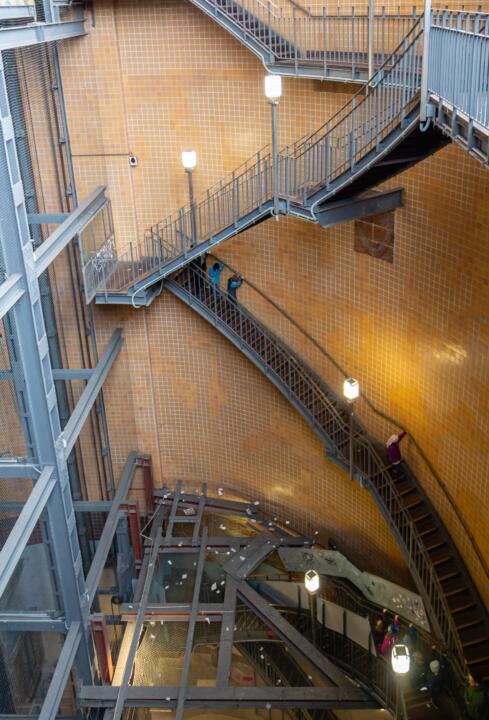
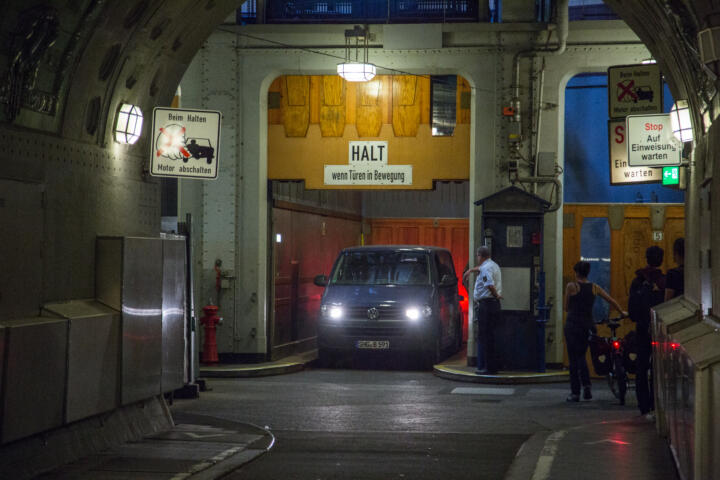
Two identical tubes, each with a diameter of 6 meters (20 feet), composed of riveted steel tubing and sealed with lead. Because the ground on the Steinwerder side consisted of water-permeable sand the workers had to dig under constant excess atmospheric pressure – a method that had hardly been tested at the time. The toll that took was that around 700 of the 4,400 workers came down with the so-called divers’ disease, to which three of them succumbed. On June 24, 1909, the excess pressure was suddenly released – and a six-meter (20-foot) high plume of water shot out of the middle of the Elbe River, with bathing guests on the shore watching in awe. Miraculously, no one was harmed. The four historic shaft buildings – two per shore, with distinctive copper domes – each accommodate four freight elevators that used to lower horse carriages in the old days and cars later. Inside the tunnel, glazed tiles with marine animal pictures adorn the walls. Construction costs back then around 10 million gold marks. Referenced to 1911 and adjusted for inflation, that corresponds to a sum of around 75 million euros.
Why fascinating?
Today, the tunnel is closed to cars but pedestrians and cyclists can use it free of charge around the clock – most recently more than one million pedestrians and 300,000 cyclists per year. Since 2003, the tunnel has been a protected monument and in 2011 the German Federal Chamber of Engineers bestowed the title “Historic Monument of Engineering in Germany” on it.
A bus that goes swimming
Amfibus
Location: Rotterdam, the Netherlands
Built in: in service since 2010
What?
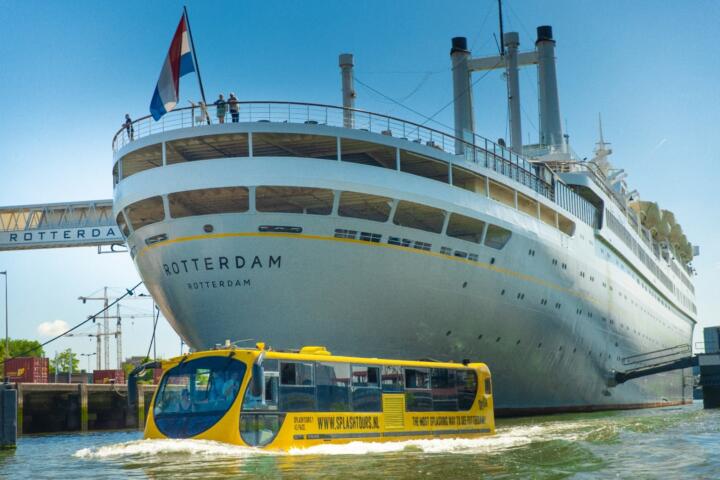
In the middle of downtown Rotterdam, a yellow line bus suddenly turns into a boat. The “Amfibus” of Splashtours first carries tourists through the streets and then – without having to change lines – into the Nieuwe Maas river. About 40 minutes on land and 20 minutes on water – that makes for a special kind of one-hour city tour. The vehicle was actually invented for Glasgow where in 2010 it was supposed to replace the Renfrew ferry across the Clyde – until an air cushion came off during a test run and the job was lost. Rotterdam took what Scotland didn’t want.
The technology behind it:
Under the hood: a totally normal Volvo chassis but a welded stainless steel tub underneath it – that’s how a bus becomes a watertight ship’s hull. A 462-hp engine powers two separately controllable waterjet powertrains in water. On the ground the speed is up to 97 km/h (60 mph), floating still up to 12 km/h (7.5 mph). The bottom edge of the window is nearly immersed in the water line – even so, the bus lies amazingly calm in the river.
Why fascinating?
Because a failure turned into a business model here: What ended in a flop in Glasgow has become an everyday practice in Rotterdam and meanwhile also in other cities – some 40,000 passengers per year, spread across more than 1.200 trips. Local residents no longer look while tourists look in awe when the bus disappears in the harbor basin in front of their eyes.