Will sailing freighters make a comeback?
Thinking about sailing freighters typically conjures up images of tall ships: mammoth masts, white sails, and long journeys on the world’s seas. Sailing vessels in fact were part of the backbone of world trade up until the 20th century.
History
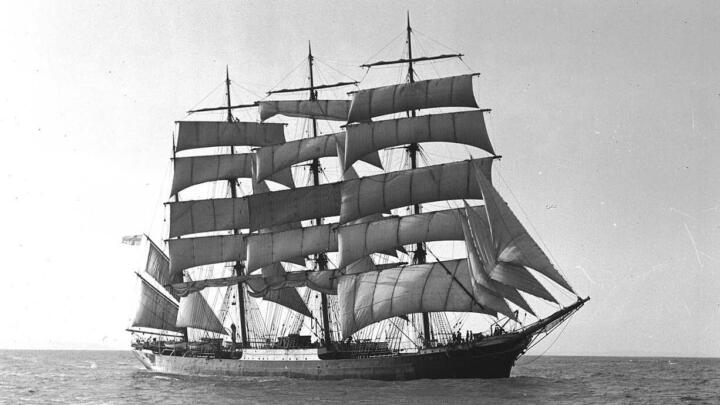
The era of large commercial sailing vessels did not end abruptly but across several centuries focused on the early 20th century. The last large sailing vessels for worldwide trade were built between the end of the 19th century and the 1920s. Especially well-known are the so-called “Flying P-Liners” of the Hamburg shipping company F. Laeisz that are regarded as the epitome of the freight sailing business. A case in point is the “Padua” that was launched in 1926 and is deemed to be one of the last large commercial cargo sailing vessels. Other ships of that generation – such as the “Pamir” (1905) or the “Passat” (1911) – were still used in cargo service up until the 1930s and 1940s. The post-war era saw the last major commercial service of these sailing freighters. The decreasing economic feasibility and rise of diesel- and steam-powered vessels largely put an end to the regular deployment of sailing freighters in global line service in the 1940s to 1950s. Only a few of these large historic sailing ships still exist today – mostly as museum ships or training units.
A few years ago, the idea of wind-powered cargo vessels has begun to receive new attention. Not for nostalgic reasons but due to one of the greatest challenges in global logistics: decarbonization.
Around 80 percent of global trade are handled by sea, according to the International Maritime Organization (IMO). At the same time, international shipping causes around three percent of worldwide greenhouse gas emissions. The industry is under increasing pressure to develop climate-friendlier solutions. The IMO is pursuing climate neutrality by 2050.
That’s why besides alternative fuels such as methanol, ammonia, or biofuels renewable energies are becoming increasingly important. Wind is among the oldest as well as the most modern options. Several current projects are showing that this subject is no longer being discussed strictly in research institutions.
Starting in 2027: transatlantic service using sailing trimarans
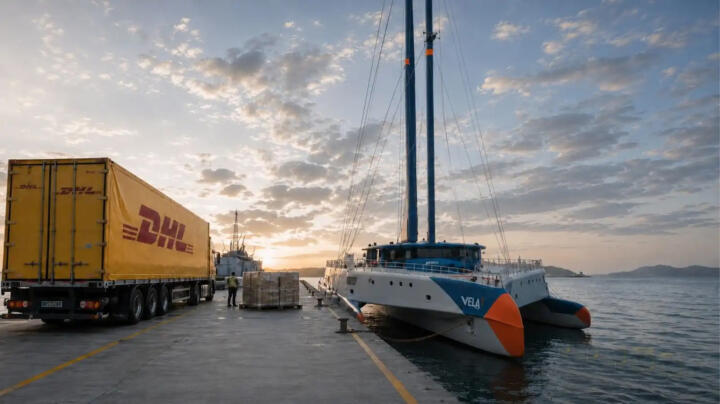
In June 2026, transportation company DHL France announced a strategic partnership with French shipping company VELA, planning to establish a regular transatlantic service between Europe and the United States in which purpose-developed 67-meter (220-feet) long trimarans are supposed to use wind as their main power source. Each of these freighters can carry about 600 Euro pallets or some 415 metric tons (457 short tons) of cargo per trip that will take about 15 days from port to port across the Atlantic.
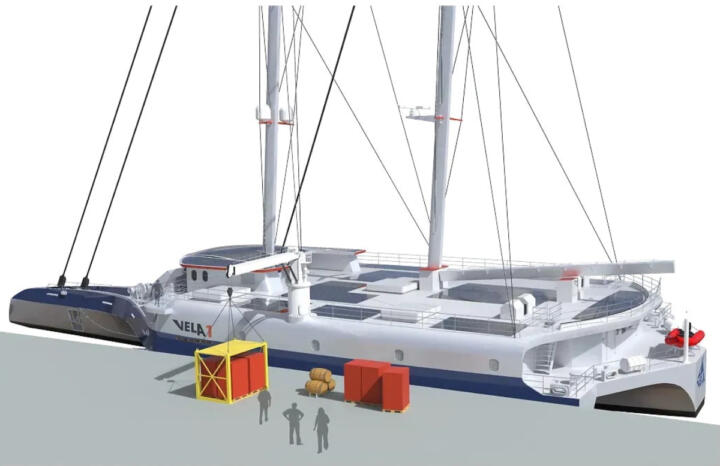
For comparison: Classic container vessels need around nine days for the crossing. The world’s currently largest container ships can haul far more than 20,000 standard containers (TEU). 600 Euro pallets typically fit in less than 60 TEU (Twenty-foot Equivalent Units).
The service to be operated by DHL and VELA is scheduled to start in early 2027 and is initially supposed to be focused on high-end niche cargo, according to the shipping operation – including pharmaceuticals, cosmetics, wine, and luxury goods. The objective is to create a new class of transportation between sea and air freight that, according to VELA, is supposed to cause up to 99 percent less carbon emissions than air cargo and up to 90 percent less than conventional maritime shipping, depending on the comparison model.
The project is supposed to be more than a technology demonstrator. The idea is to create a scheduled line service with wind-dominated cargo ships that can be integrated into regular logistic chains. “The partnership with DHL France makes wind-powered transatlantic freight accessible to more customers,” says Michaël Fernandez-Ferri, VELA’s managing director.
Setting sails for line service
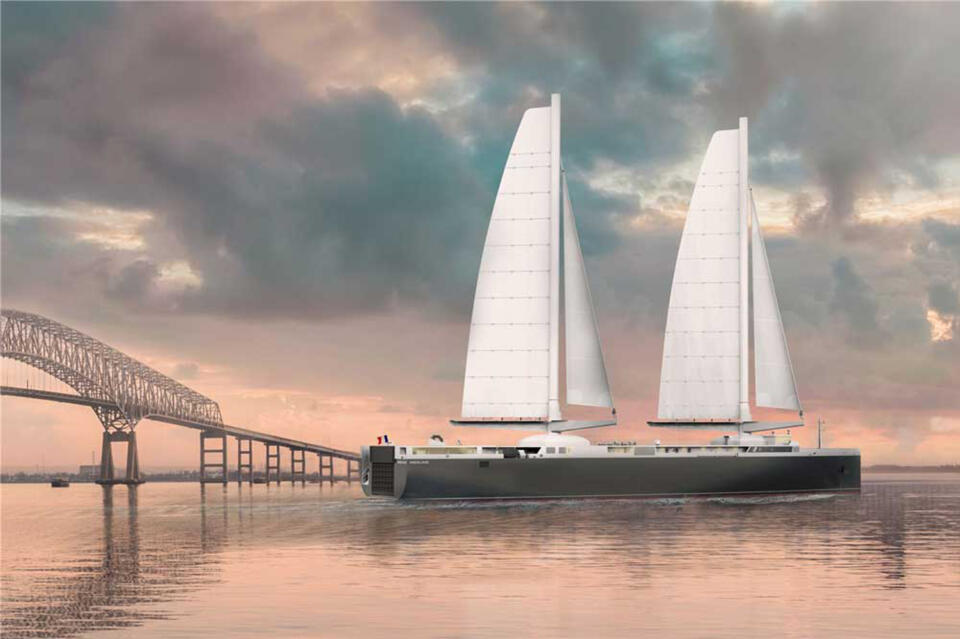
VELA is not alone. French company NEOLINE has been pursuing the goal to put sailing vessels back into regular line service for several years as well. The 136-meter (446-foot) long “Neoliner Origin” that’s mainly powered by wind as well crossed the Atlantic for the first time at the end of 2025 – in just about eight days. Its destination was the port of Baltimore. In the future, a monthly line service is supposed to connect Saint-Nazaire in France with Baltimore – enroute the ship is going to stop at Saint-Pierre et Miquelon and Halifax.
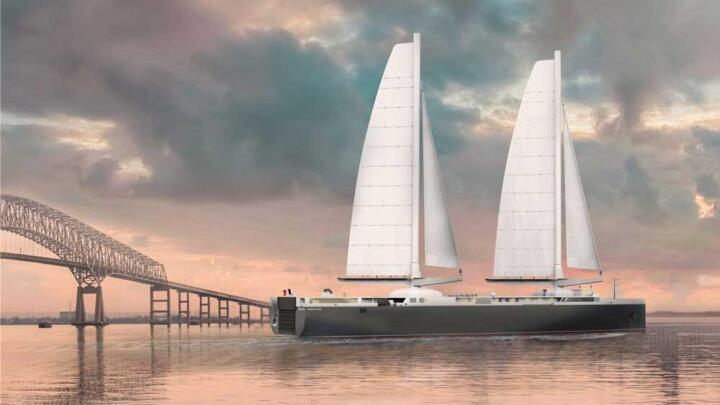
With a total sailing area of 3,000 square meters (32,300 feet) the ship can achieve speeds of around eleven knots. The two purpose-developed large sails made of carbon can be unfolded like a concertina. The two masts that are around 90 meters (295 feet) tall can be folded, reducing the total height to about 42 meters (138 feet) – a crucial advantage when entering ports with bridge restrictions. The cargo capacity is 5,300 metric tons (5,850short tons) or 265 standard containers.
Large container shipping companies are rethinking their operations as well
The transformation is even more evident in the case of the world’s largest container shipping companies. Although no-one is contemplating the use of pure sailing ships there at the moment more and more companies are investigating how wind power can reduce the consumption of alternative fuels. Hamburg’s tradition-steeped shipping company Hapag-Lloyd has extensively explored that question as well.
“In a special research and development study, we’re evaluating the potential of wind power as a possible decarbonization action for our future fleet,” explain Christoph Thiem, Director Strategic Assets Projects, and Martin Köpke, Manager Regulatory Affairs & Sustainability at Hapag-Lloyd.
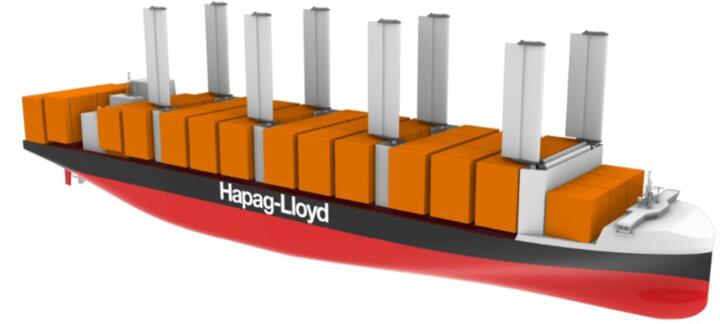
The question they’re asking is how wind powertrains can be integrated into future container ships. The investigation is centered on a possible concept for a container ship with a length of around 260 meters (853 feet) and a capacity of some 4.500 TEU. The plan is to use a hybrid system: Alongside a conventional powertrain – that may also use alternative fuels such as methanol – several sails are supposed to be installed. A concept study mentions eight masts with a total sailing area of some 3,000 square meters (32,300 square feet). For comparison the German sailing training vessel Gorch Fock has a sailing area of around 1,800 square meters (19,375 square feet).
Computer simulations are supposed to show how large wind-assisted vessels behave under real-world weather conditions and how much than can reduce energy consumption. Another approach is weather-based route optimization: in the future, ships could more effectively navigate along more favorable wind fields.
A comeback of sailing freighters – but not the same as before
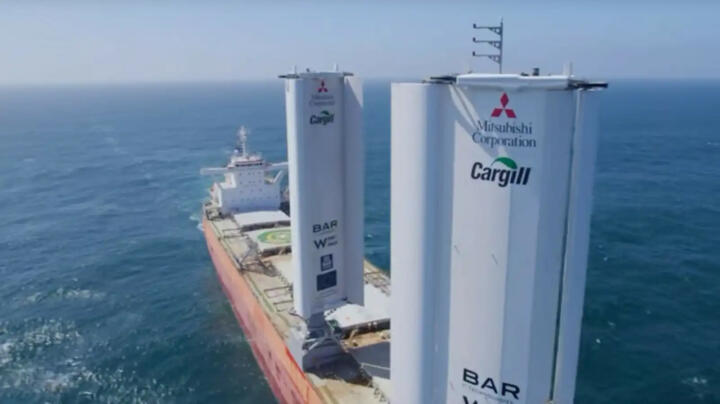
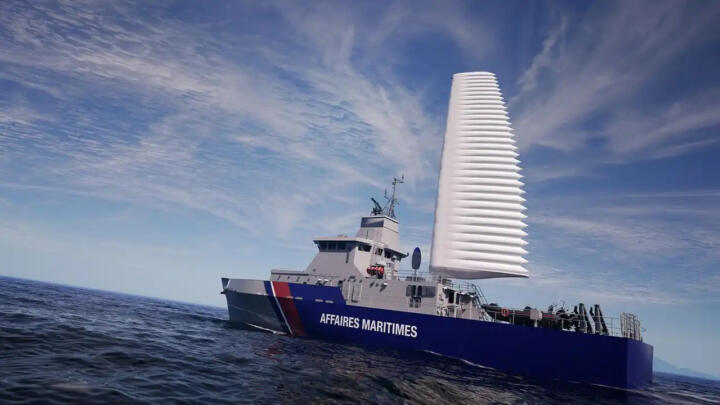
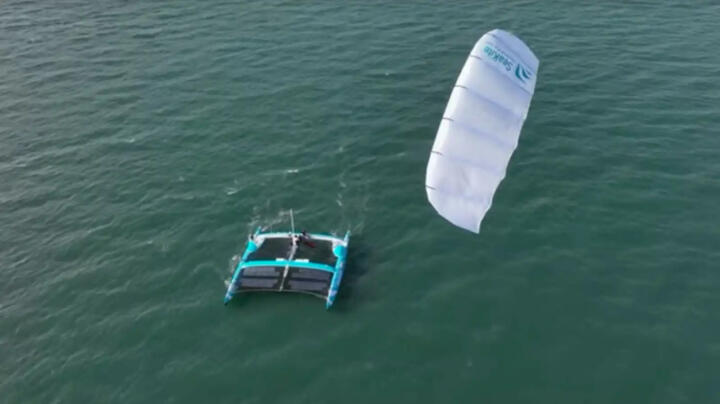
Despite the growing attention being paid to wind-assisted systems the technology is not regarded as having been fully developed yet. Rigid wing sails, kites, or so-called Flettner rotors are still largely in a development stage or still only being tested on individual ships.
That’s why experts are talking less about a comeback of the classic sailing freighters and more about a revival of wind powertrains in a more modern form. Knut Ørbeck-Nilssen, CEO at ship classifier DNV, emphasizes that “all options for decarbonization should be investigated. Wind-assisted propulsion systems are already showing considerable reductions, especially if they properly fit the type of ship and operating profile.”
Particularly attractive is the fact that the technology can frequently be retrofitted. According to DNV, some 75 percent of all propulsion systems are currently installed on existing wind-assisted propulsion systems, especially tankers and general cargo freighters. Retrofitting is regarded as a decisive lever to achieve short-term emission reductions.
The German Aerospace Center (DLR) regards the development as a structural transformation in maritime shipping as well, saying that wind will “increasingly become standard” in maritime propulsion technology, albeit not as a stand-along solution but as part of hybrid energy system of alternative fuels, more efficient hulls, and digital route planning.
“We are currently observing a clear upward trend. According to the International Windship Association (IWSA), more than 100 large ships are now powered by wind propulsion. In the last six months alone, there has been an increase of over 25 percent,” says Lars Schmitz, a naval architect and expert in wind propulsion at DLR.
The bottom line is that there probably won’t be any nostalgic comeback of sailing freighters but rather a multi-faceted technological reinterpretation.
Schaeffler in maritime shipping
Motion technology company Schaeffler supplies high-precision rolling and plain bearings as well as propulsion components to the maritime industry. The components are designed for harsh conditions due to salt water, among other things.
Read more about that here.


