Steering reimagined
For decades, Schaeffler has been engaged in controlling motion in more efficient, safe, and intuitive style. By continuously developing its chassis expertise – from high-precision mechanical components to mechatronic steering systems to by-wire actuators – the company has created a technology kit that paves the way toward automated mobility.
“In recent years, Schaeffler has continuously extended its portfolio from chassis components to modules and mechatronic systems. We want to offer vehicle manufacturers innovative high-performance solutions in terms of vehicle dynamics, comfort, and safety. Steer-by-wire plays an important part in that endeavor.”
Clément Feltz, President of Schaeffler’s Chassis Systems business division
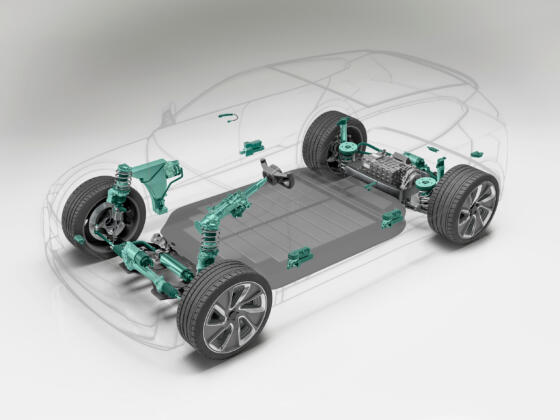
In the case of steer-by-wire systems, steering commands are no longer transmitted via mechanical connections but by electronic signals. Multiple redundancies ensure maximum failure safety. At the same time, the elimination of the steering column opens up completely new design options for the cabin: control elements no longer need to be connected to a fixed place in the cockpit, thereby enabling all-new human-machine interfaces (HMI) – with joysticks or totally new forms of input devices that are always optimized in terms of ergonomics and ease of use.
1. Electrical steering
New intellectual approaches
Schaeffler has been developing components for electromechanical power steering for several years and, most recently, products and solutions for the next evolution in terms of steering too: steer-by-wire. This opens up opportunities to reimage steering systems by automotive OEMs as well as drivers to maximize the benefits of this new technology. One of Schaeffler’s competitive advantages is the company’s high level of vertical integration: The combined automotive product portfolio from the merger with Vitesco Technologies enables completely new intellectual approaches and innovative solutions – not least in terms of steering. “In times of transformation, Schaeffler with its by-wire solutions on component and actuator levels offers innovations developed in Europe with massive potential to make steer-by-wire technology standard equipment for mobility of tomorrow,” says Benjamin Severin who heads the steer-by-wire product group.
2. Hand Wheel Actuator
Maximum Potential
Schaeffler’s steer-by-wire architecture is centered on the Hand Wheel Actuator (HWA) enabling individual adjustment of the steering wheel and – as a particularly beneficial feature in the by-wire context – space-saving stowage as needed. As a result, vehicle manufacturers can create all-new cabin concepts: the HWAs allows flexible integration of the steering wheel or even complete stowage in the dashboard.
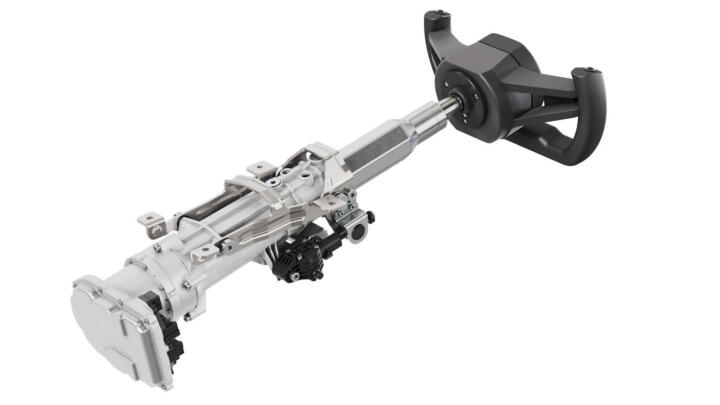
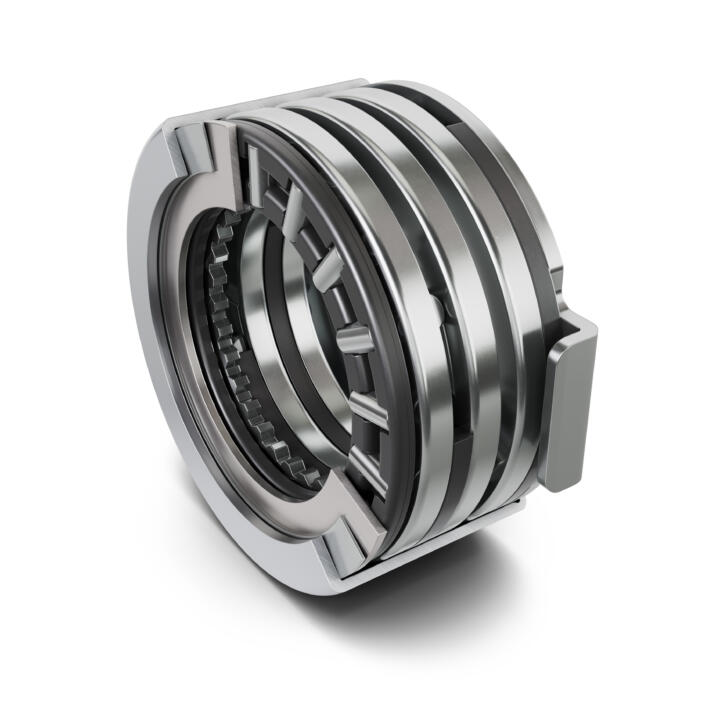
Schaeffler has been developing its HWA since 2020, drawing on its extensive bearing know-how in that project. Roller-based angle limiters enable a robust solution that’s suitable for large adjustment and insertion travel. In addition, rolling bearing-based solutions are used for the mechanical rotation angle limitation. The company’s lightweight design expertise – for instance in sheet metal forming – contributes to high efficiency and performance.
Technology expertise from a one-stop shop
A major benefit for vehicle manufacturers is Schaeffler’s combination of all relevant types of expertise and technologies under one umbrella – from simulative engineering to modern steering system manufacturing – including:
- High-precision bearings
- Mechanical components
- Electronic components (electric motors, sensors, electronic control units, magneto-rheological powder brakes)
- Software and function development
All of that combined enables fast development cycles, high adjustability, and solutions that are precisely tailored to customer needs.
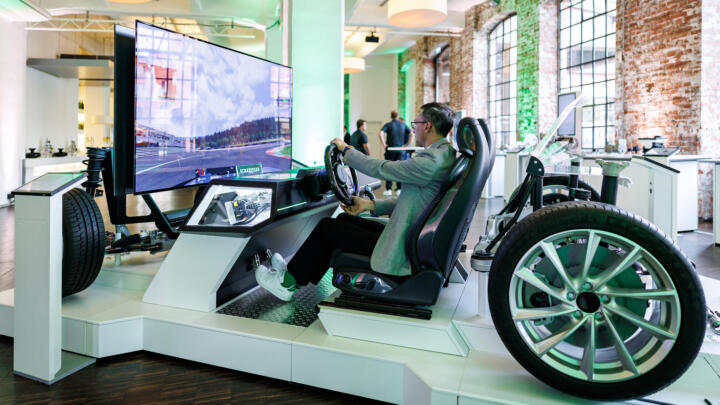
3. Force Feedback Actuator
Tangible control in any situation
Within the Hand Wheel Actuator, the Force Feedback Actuator (FFA) translates the steering command into an electrical signal on the one hand and on the other generates the desired steering feel, regardless of whether the input occurs via a steering wheel or an alternative human-machine interface (HMI) like a joystick. As part of the HWA, the FFA defines the feel of the steering. “Schaeffler combines a direct-drive electric motor with a magneto-rheological powder brake (MRP), a modern technology that generates resistive forces very quickly, precisely, and energy-efficiently,” says Benjamin Severin.
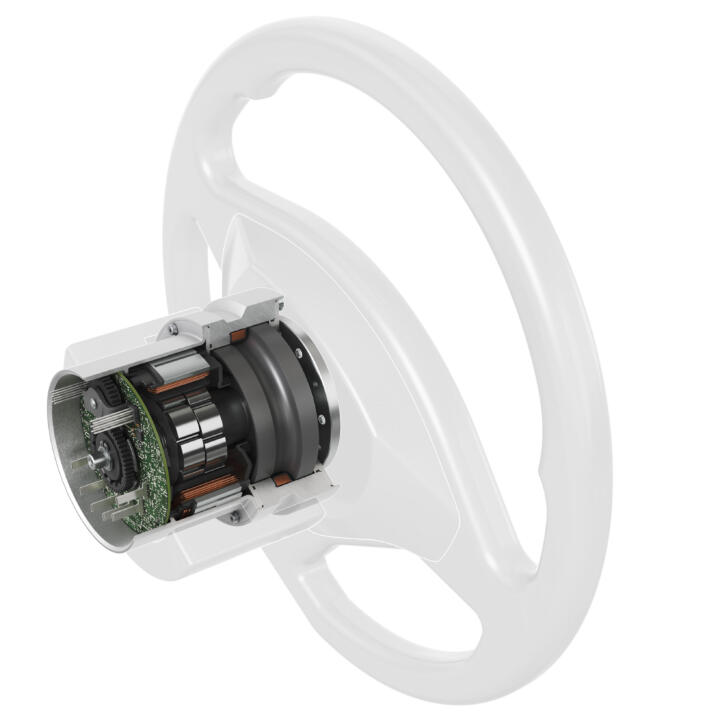
An MRP brake enables configurable steering feel for precise and repeatable hand-generated torque. Using nearly wear-free components, an FFA has long life with very high energy efficiency combined with lower use of rare-earth magnets. The integrated electric motor is part of Schaeffler’s portfolio as well. The brushless direct current motor equalizes torque fluctuations (torque ripple). Schaeffler complements its components by innovative, contactless sensors – whether for single-turn or multi-turn applications – according to customer needs that the company develops at its site in Toulouse.
“With the FFA, Schaeffler offers a reliable and redundant steer-by-wire product featuring modularity,” explains product group head Benjamin Severin. It is equally suitable for passenger cars as well as light and heavy commercial vehicles. The core components can be produced by the millions and integrated in various model ranges. The vehicle-specific definition is on the software side. For vehicle manufacturers, that means a wide variety of use cases combined with minimal part number variance. In addition, they benefit from a wide range of FFA configurations: from steering torque variability of up to 35 newton meters, highly dynamic responsiveness, and adaptive safety architecture for the most exacting demands. Especially for commercial vehicles, Schaeffler has been working for some time on solutions to integrate the FFA into the driver’s cabin in new ways.
4. Joystick
More than a gimmick
The Hockenheimring racetrack on a morning in late fall. Instead of a bulky steering wheel and intrusive steering column the GT sports car has only two joysticks and precisely follows their slightest movements. What appears like an experiment is already showing today what could look like a new form of mobility of the future. The joystick prototype on the Hockenheimring is no mass product but proves how much freedom of design is generated by eliminating the mechanical steering column. Controls can be reimagined as minimalistic, shiftable components, or in all-new ways. The joystick demonstrates that type of potential in its purest form: precision steering, minimal design space, new kinematics.
Schaeffler uses joystick demonstrators as a development platform for testing various operating concepts – always based on the same safe and modular steer-by-wire architecture.
Conclusion: The way forward
Whether with a classic steering wheel or using a joystick – the future of steering systems will be software-defined, flexible, and freely designable. HWA and FFA provide the technical core for that. The joystick used at the Hockenheimring provided an initial glimpse of that freedom with the underlying technology showing that Schaeffler is pursuing this path into a new era of steering with consistency, a modular style, and a clear objective – to make motion smarter and more automatable.