Production reimagined
The mechanics behind humanoid robotics
It’s a fact that humanoids will not be able to move like humans without the right mechanics.
That’s the point at which motion technology company Schaeffler comes in with an innovative actuator platform. Actuators are the components that translate electrical energy into motion. They sit in shoulders, elbows, knees – and ultimately determine how precisely, efficiently, and naturally a humanoid robot moves.
Actuators account for about half of the total costs of a humanoid robot. Manufacturers that build them in better and more efficient ways not only change a component but the economy of the entire robot. That’s important for many manufacturers worldwide because the demand for highly efficient articulated drives is growing.

“Hardly any other technology at Schaeffler more effectively illustrates the great potential behind the idea than actuators by means of which energy can be translated into mechanical motion. And especially in conjunction with the potential of AI it becomes evident that this is a key technology for the breakthrough of humanoid robotics.”
Schaeffler wants to make a decisive contribution to get humanoid robotics ready for industrial uses in large numbers and is going to launch mass production of components before the end of 2026. The approach is based on a consistent industrial concept: development, production, and supply chain are closely integrated with the objective of a fast ramp-up that can be flexibly adjusted.
In the background are processes that Schaeffler has already been familiar with as an automotive supplier. Twelve core manufacturing technologies will be used including highly automated winding methods for electrical spools or particularly thin rolling bearing rings (just one millimeter thin) to be produced without machining technology.
Motion that works
From a technical perspective, Schaeffler’s actuator platform is about rotative actuators – i.e. drives that generate rotative motion. They sit in the central joints of a robot such as shoulders, elbows, and knees where they determine how forcefully, precisely, and ultimately “humanly” motion is executed.
30 actuators
approximately are installed in a humanoid robot. Many of them can be derived from automotive industry components.
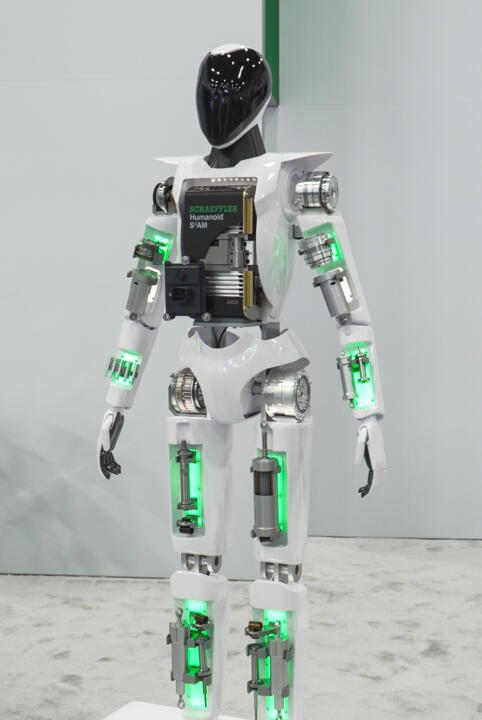
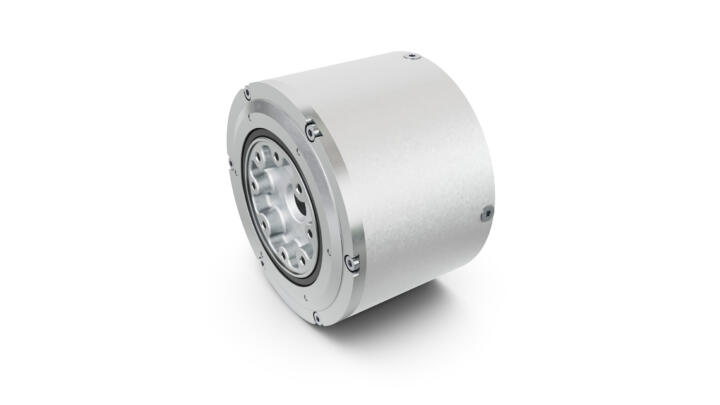
Schaeffler’s solution concentrates several functions in one system: the electric motor, power electronics, and sensors work closely together. In addition, there are modular gearboxes that can be adapted depending on the application.
The difference is primarily evident in the structure. Due to integrated bearings in the rotor, the available space is used more efficiently and the system as a whole has less weight. At the same time, torque remains high. This results in a more compact system that can be integrated into different robot models more easily.
What initially sounds like technical fine-tuning has a major impact. A design size that’s reduced by a few millimeters can make a difference in terms of how efficiently a joint can be designed. A few hundred grams less weight affect energy consumption and dynamics.
Award-winning foundations
For exactly this approach – the combination of technological integration and industrial scalability – Schaeffler has now been recognized with the Hermes Award. The award is regarded as one of the most important international accolades for industrial innovation and was presented during the opening of the Hanover Fair on April 19. The fair itself will continue until April 24.
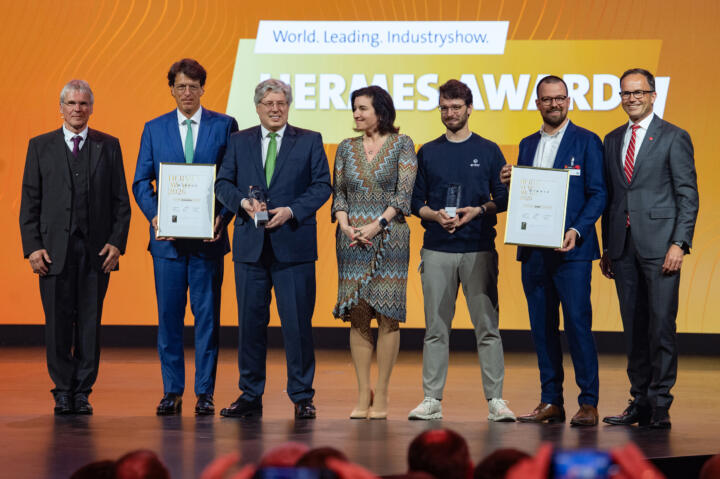
An independent judging panel selected the actuators platform among several nominees. The award was presented by Dorothee Bär, Federal Minister of Research, Technology, and Space in the presence of Federal Chancellor Friedrich Merz. This year’s selection was particularly focused on the combination of mechanics and artificial intelligence.
Schaeffler plans to use humanoids in its plants
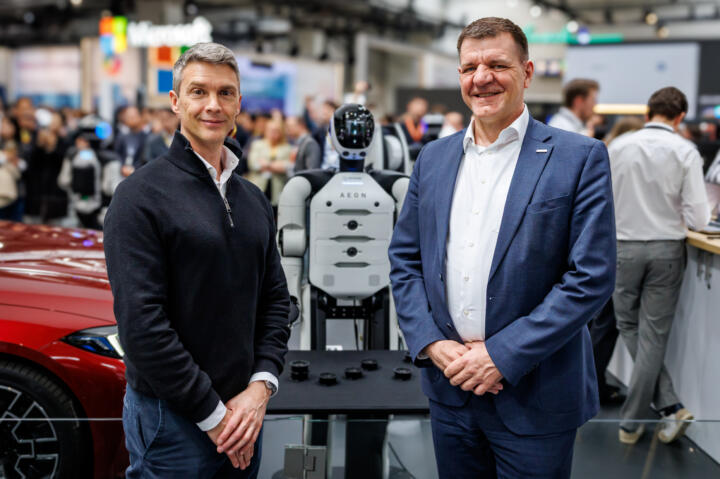
Schaeffler is building a strong worldwide network of partners to roll out humanoid robotics in industrial settings. One of the most recent cooperations is the partnership with Hexagon Robotics in Switzerland. At the core of the cooperation are high-precision actuators from Schaeffler’s award-winning platform that serve as key technologies for scalable robotic systems.
At the same time, Schaeffler is planning to deploy humanoid robots from Hexagon Robotics in its global production network. Read more about the partnership here.
The setting in which robots learn: the Industrial Metaverse
While the actuators enable motion another question is raised: where and how do machines learn to use that motion sensibly?
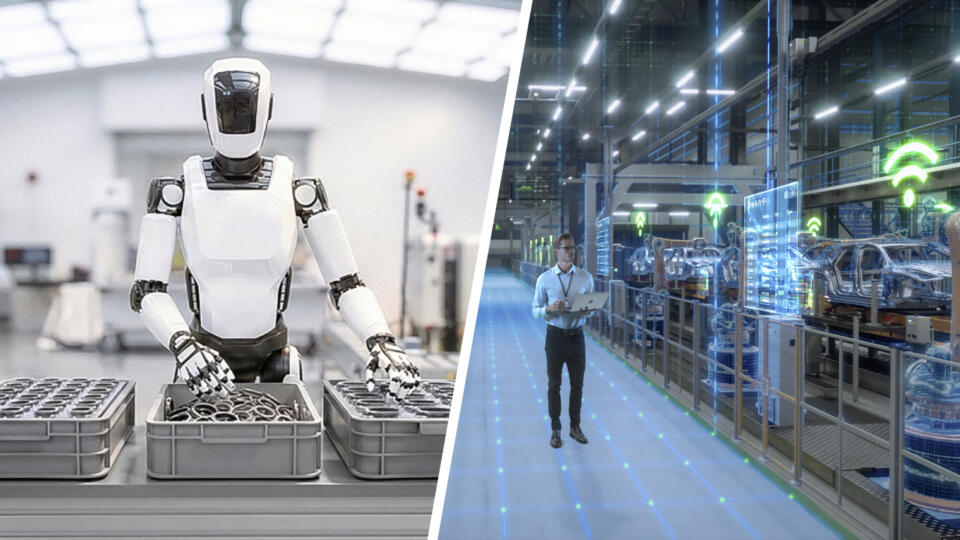
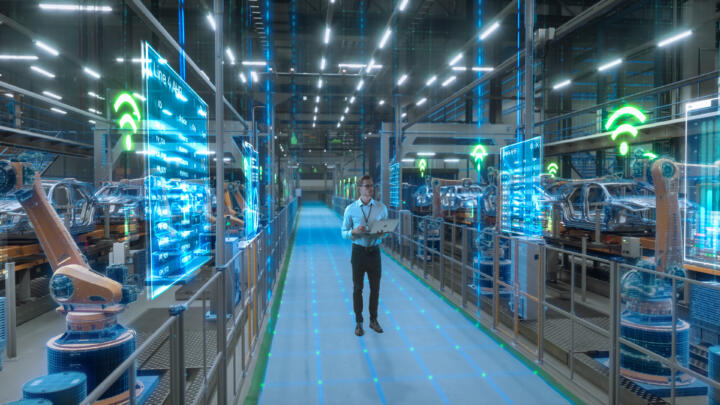
Schaeffler’s answer to that is the Industrial Metaverse – a term that sounds like a buzzword but has a very specific function in the company. It’s about the combination of real-world manufacturing and digital simulation. It’s about imaging a factory that not only visualizes but understands, calculates, and optimizes.
A second image of reality
In its core, the Industrial Metaverse combines two levels. On the one hand, there’s a virtual image of the factory – with adequate detail to model real-world processes. On the other hand, simulations are running that emulate physical processes as accurately as possible.
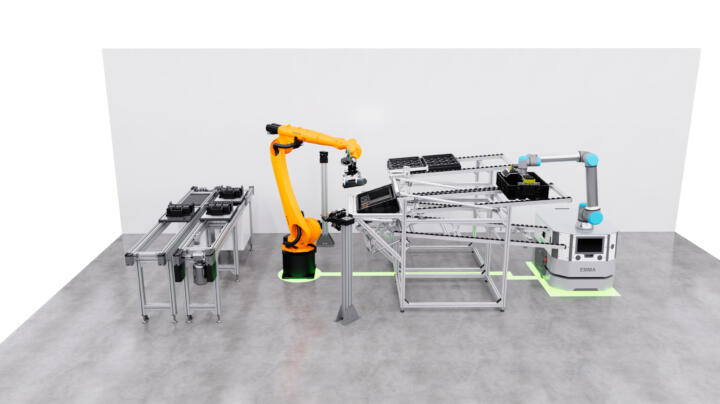
The crucial point is the linking of both worlds. Data from real-world manufacturing are fed into the model. At the same time, scenarios are run in the virtual world before being implemented in the real world. This results in a kind of second operating system for the factory.
Learning without stopping
That becomes particularly evident in the case of autonomous systems. Driverless transportation vehicles, robots, or complex machine control systems are no longer optimized strictly while they’re running. They learn in the digital space beforehand.
The utilization of so-called physical AI makes that possible. Sensors supply data, algorithms recognize patterns, derive decisions from them, and test them directly in simulation. Motions of robots are being trained virtually and adjusted to real-world environments.
That has a practical effect: processes that used to be regarded as being too complex or costly can be automated for the first time. Not because the reality has become simpler – but because there’s a better understanding of it.

“For us, the Industrial Metaverse is far more than just a means to optimize processes. It is the key enabler for the scaling up of humanoid robots, as cyber-physical systems can already be trained by physical AI in the virtual space quickly and efficiently. By using the Industrial Metaverse, we are paving the way for flexible, high-level automation and greater efficiency in our worldwide volume production.”
Scaling instead of standalone
What sounds like an experiment has long been implemented. The Industrial Metaverse is already in use at ten of Schaeffler’s locations and planning continues: by 2030, about half of all plants are supposed to be integrated.
The approach behind this is clear. It’s not about isolated optimization but about a system that’s scalable. About a factory floor that operates in data-driven ways, continuously adapts – and acts increasingly autonomously.
This logic also illustrates why humanoid robotics plays a role here. It shouldn’t be looked at in isolation but as part of a larger composite: a production environment that prepares, simulates, learns, and enables efficient use of AI.

Recognition for a digital ecosystem
Schaeffler has now been recognized for its Industrial Metaverse with the German Innovation Award in the “Large Enterprise” category. The award is presented annually by WirtschaftsWoche magazine together with several partners under the patronage of the Federal Ministry for Economic Affairs and Energy.
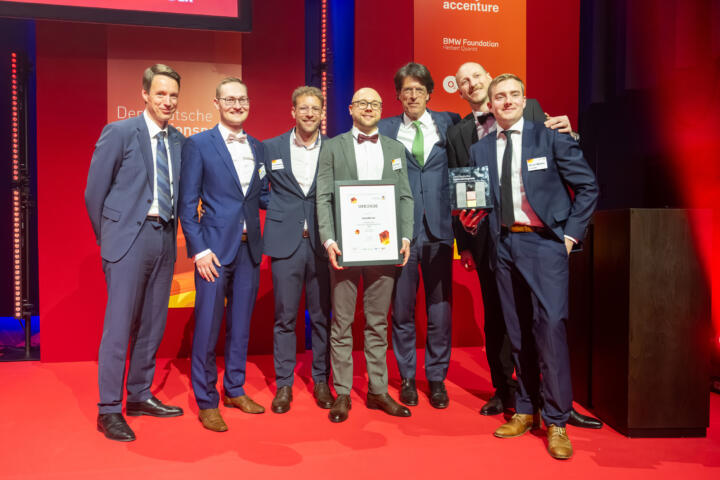
The award recognizes companies that strengthen Germany’s and Europe’s competitiveness with their innovations. In Schaeffler’s case it’s less about a single product but a system: the combination of real-world manufacturing and digital simulation – and the idea that the future starts in the virtual world first.