My vacation, my robot
Automation in the tourism sector is moving forward. Incessantly. Sometimes in small steps and at others at a rapid pace, depending on which part of the world it is. Not always is technological fascination the only driver of progress. Shortage of personnel is a key engine. An insufficient number of human service providers meet with too many travelers.
Hotels, restaurants, and other operations in the tourism business are desperately looking for employees around the globe – especially now in the main travel season when tourist regions are reaching their capacity limits and millions of vacationers have to be taken care of simultaneously. At the same time, guests expect fast service, multilingual support, and 24/7 availability. More service robots that could pick up the slack provide a possible solution.
By 2050, nearly one billion humanoid robots could be deployed worldwide according to an analysis by American investment bank Morgan Stanley. Besides industry, the service sector, especially where many processes are standardized and repetitive, are seen as growth drivers. Even today, specialized robots – with more or less human characteristics – are working in clearly visible ways in the hotel and restaurant business. They serve food and beverages, accompany guests to elevators, deliver luggage to hotel rooms, and assist personnel with routine tasks.
Asia as a trailblazer
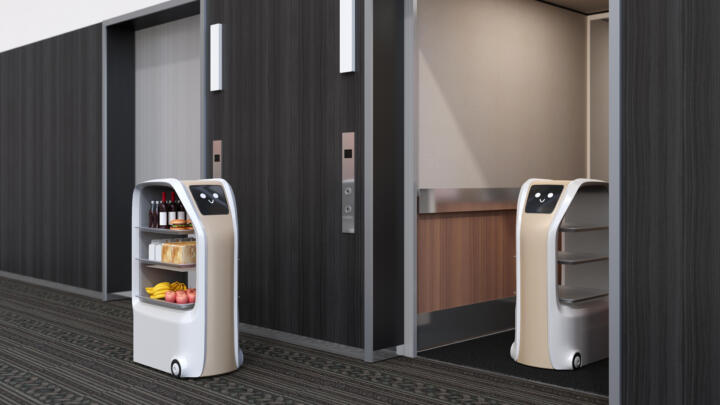
Especially tourists visiting Asia are going to meet service robots in many places. A particularly widespread example is autonomous delivery robots. They independently run through hotel hallways, recognize obstacles thanks to sensors and cameras, and make deliveries directly to hotel room doors.
German tech company Neura Robotics, with which motion technology company Schaeffler has entered into a strategic partnership for the joint development and supply of key components for humanoids, with its model 4NE1 is taking a step beyond classic service robotics and would like to integrate humanoid robotics into hotel operations.
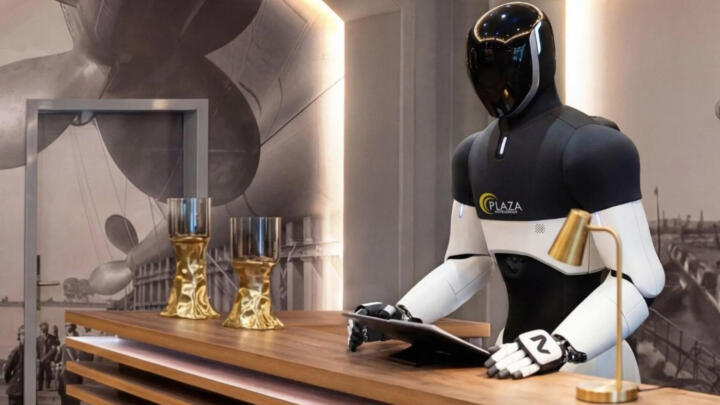
The Neura robots are supposed to support employees of collaboration partner “Plaza Hotelgroup” with a variety of tasks at the reception desk, in service, and in housekeeping operations. The systems are being trained in so-called “Neura Gyms” where the robots learn and practice real-world work situations.
“Our sector is in a state of transformation. Together with Neura Robotics, we develop specific solutions for everyday hotel operations.”
Yonca Yalaz, CEO of the Plaza Hotelgroup
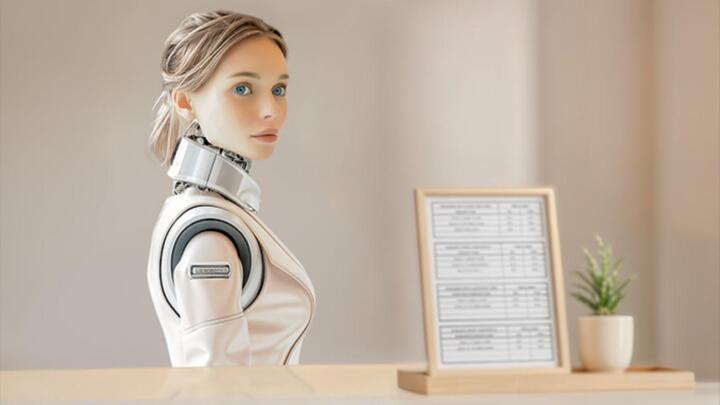
With its receptionist robot, Czech robotics specialist Flae Robotics targets the acute personnel shortage in the hotel business as well. The autonomous front office assistant takes care of check-ins, answers questions of guests in more than 100 languages and can be seamlessly integrated into existing hotel management systems. Following successful deployment in the Czech Republic and the United Kingdom, the startup is now planning to develop the markets in Germany, Austria, and Switzerland.
Robots increasingly human-like
The next generation of robots seems to be looking increasingly like humans. That’s no coincidence because humanoid machines are planned to pick up the slack wherever hands are lacking – at hotel reception desks, in room service, as well as in hospital settings, in logistics, and on the factory floor. With its new model U1, Chinese robotics company Ubtech is showing the rapid pace of that development. According to the company, the world’s first mass-produced humanoid robot has more than 88 servo joints, can emulate up to 90 percent of human movements, and shows 300 micro-expressions – including blinking. Its silicone skin with pores and delicate wrinkles not only appears to be amazingly real but is supposed to feel nearly like human skin too.

Autonomous hotel planned in China
In the Chinese metropolis of Shenzhen even a complete hotel is currently in the making that from 2027 on is supposed to be operated largely autonomously. Artificial intelligence and specialized service robots are supposed to take care of nearly all operational processes – from check-in and check-out to transporting luggage to cleaning rooms, to service in the restaurants.
Whether this concept will pan out remains to be seen. A look at Japan shows that the road toward a fully automated hotel is stonier than frequently suspected. The Henn na Hotel that was launched as a showcase project had to decommission a large part of its robots again in 2021 after language assistants had misunderstood guests, service robots failed in handling routine situations, and the additional technical effort partly thwarted the expected efficiency gain. The conclusion that was drawn back then: robotics add most value in areas where they perform clearly defined tasks and not where they’re supposed to fully replace human interaction.
“Robotics and intelligent assistance systems don’t replace humans in hotels – they create freedoms for the things that hospitality is truly about. Whether in serving guests and providing concierge support, room service and housekeeping, in the food & beverage area, or in back-of-house logistics: they add the greatest value by strengthening personal service and systematically easing the burden on employees.”
Analysis by the Swiss hotel management school “École hôtelière de Lausanne”
Robots in airports
The robotics revolution doesn’t stop at hotel doors. Airports around the world are increasingly using smart helpers as well – from service settings to apron operations. At Tokyo Haneda Airport, Japan Airlines is testing robots that haul luggage and cargo and may be able to assist with cleaning and maintenance jobs in the future as well. The reason is the same as in hotels and restaurants: labor shortage that meets with growing numbers of passengers.
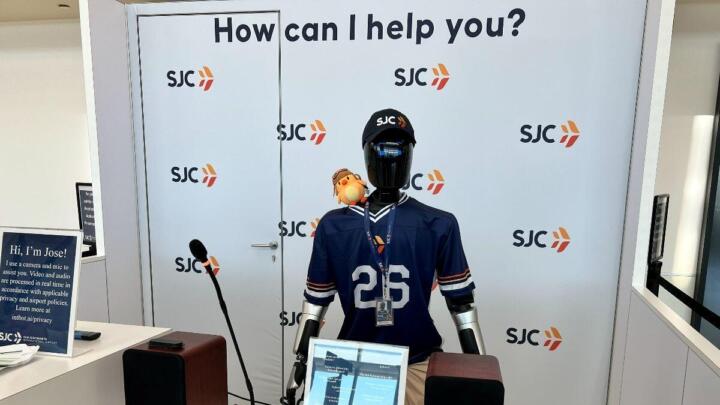
At San José International Airport in California, “José,” a humanoid AI assistant, welcomes travelers. He answers questions, provides flight information, and communicates in more than 50 languages. The message behind the projects is that the airport of the future won’t be devoid of people – but increasingly supported by digital colleagues.
Robots in restaurants acting more autonomously than in hotels
Not only hotels but restaurants are increasingly discovering robotics for themselves. Service robots have by now become part of routine operations in many establishments. They transport plates from the kitchen, collect dishes, or serve drinks. They independently navigate between patrons and reduce long walks for personnel.
Service robots easing the burden on people or completely performing hospitality tasks are no longer pie in the sky. In 2025, for instance, at the El Prat Airport in Barcelona, Spain, an AI-supported robotic restaurant called SELF was opened. The process is remarkably simple: Travelers place their orders at digital terminals, and subsequently a robotic arm with grippers and five tactile fingers issues the ordered items. By means of artificial intelligence and camera technology, the system recognizes products, prioritizes orders, and can manage up to six orders at the same time. Coffee, snacks, sandwiches, or drinks reach waiting passengers nearly autonomously in that way.
There are many similar examples worldwide. In the United States, Nala Robotics opened One Mean Chicken, one of the first AI-controlled restaurants in which robots perform almost the entire cooking process, as early as in 2021. In Germany, at the restaurant chain “Sausalitos” in Munich, the first robotic bar was launched in 2022. Robotic arms mix cocktails while the patrons order by means of a QR code. And at the Winter Olympics in Beijing in 2022, robots served burgers, beverages, and full menus in nearly contactless processes. The technology is impressive – but a journalist also put the limits in a nutshell: “I’m missing the fact that my food is simply served to me by a real human.”
A market worth billions is behind all that
Even so, the market for robotics in the hotel and restaurant business is growing faster and faster. The worldwide market volume is expected to grow to some two to three billion U.S. dollars, depending on the market research institute. The forecasts expect annual growth rates between 17 and 25 percent. The aforementioned skilled labor shortage, increasing HR costs, progressing digitalization, and growing acceptance of automated services are deemed to be the key drivers.
Business consultants at Mordor Intelligence, for instance, expect the market to grow from 760 million U.S. dollars in 2026 to around 2.23 billion U.S. dollars by 2031. Allied Market Research even predicts an increase to more than three billion U.S. dollars by 2030.
Facts and figures
Source: International Federation of Robotics
Conclusion: a new division of labor
The real revolution is not the robot but the fact that roles are changing. Machines are performing travel, transportation, and routine jobs. Artificial intelligence answers standard questions within seconds. Humans on the other hand are becoming more important where technology reaches its limits: in terms of attention, empathy, improvisation, and true hospitality.
Maybe that’s exactly where the future of travel lies. Not in hotels without people – but in hotels in which people finally have more time for their guests again because robots relieve them of routine jobs. As a result, there won’t be competition between the concierge and the cobot but potentially a new division of labor in the hotel business.
Schaeffler and humanoid robots
Motion technology company Schaeffler positions itself as an important supplier and industrialization partner for the up-and-coming sector of humanoid robots. The company supplies key components such as precision gearboxes and actuators – the joints and muscles of the robots. In addition, Schaeffler uses the machines in its own manufacturing operations. Schaeffler views itself as a partner for the entire ecosystem of humanoid robots. Read more about that here.