Flying on a train
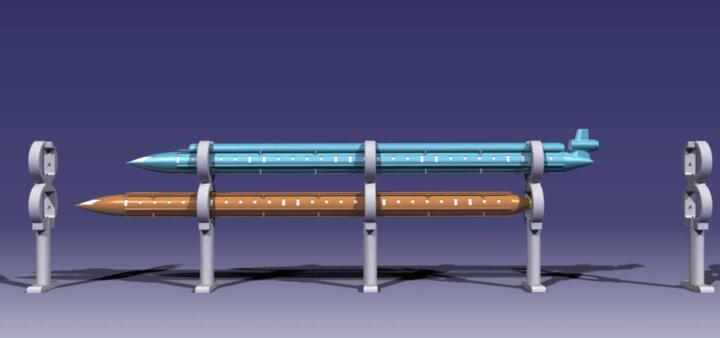
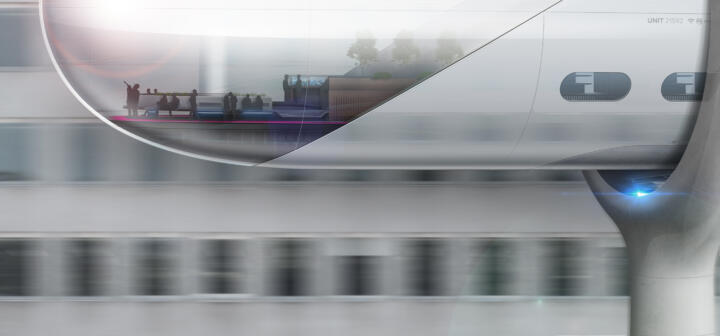
The train with a length of 250 meters (820 feet) is supposed to travel at a speed of 800 km/h (500 mph) – without an onboard propulsion system. Propelled through a connected system of electromagnetic portals perched on 20-meter (65 feet)-tall pylons in the countryside, the maglev Aeroslider would use no rails, tubes or other physical stabilizers but have a unique feature: reservoirs in the capsule filled with helium to reduce the weight of this “rocket.”




It remains to be seen whether the train will ever zip from Moscow to Shanghai in 12 hours as imagined. But, as Albert Einstein said: “If at first the idea is not absurd, then there is no hope for it.”
This is how the aeroslider could link Eurasia with Africa
The History of a Trackless Transportation Technology
The idea of a new generation of trackless high-speed systems clearly did not emerge overnight. In addition to the concept described above—such as the AeroSlider—there were also earlier engineering developments that followed the same basic principles. For example, as early as 2012, rail vehicle engineer Naveen Kumar Chaudhary developed the Ringway Transportation System, a patented concept for a trackless, elevated transportation technology featuring a contactless electromagnetic drive and a vehicle architecture based on the so-called cantilever principle, in which a train is guided along an elevated support structure rather than running on a traditional pair of rails. Chaudhary’s further developments were also patented in 2020. Further details can be found here.